Your store open, taking payments and ready to sell in 5 weeks.
Building the store is not the hard part. The order is. Almost everyone starts by picking a theme and ends up, six months later, with a good-looking store that does not know who it sells to or at what margin. The decisions come first. The store is the consequence.
What it actually takes to build an online store from scratch
Building an online store from scratch means closing the business decisions that hold it up first — what you sell, at what price, at what margin, how you take payment and how you ship — and then building the store on top of them. The technical part is a matter of weeks: what stretches a launch out to six months are the decisions left until the end.
Opening nearly five months late does not cost nothing. It costs the months you did not sell. Using the example numbers of a small store starting at around €3,000 a month:
| Open in 6 months | Open in 5 weeks | |
|---|---|---|
| First order | Month 6 | Week 5 |
| Months selling in year one | 6 | 10 |
| Revenue in year one | €18,000 | €30,000 |
| Difference | — | +€12,000 |
The revenue figures are examples, not a promise: they depend on your product, your price and what you spend on being found. The only part that depends on me is the top two rows — when you open — and that part goes in writing.
- You have a product, or a supplier lined up, and you want to sell it online
- You would rather open properly than open fast and rebuild in six months
- You want to run the store yourself afterwards, without depending on anyone
- You know what you are selling, even if you have no idea how to build it
- You can spare a few hours a week for business decisions
- You have not decided what you are going to sell — that comes first, and it is not my call
- You want the cheapest store possible: there are €300 themes for that
- You expect sales to arrive just because the store exists
- You want to sell on Amazon or Etsy: that is a different business and not mine
- You already have a store and what you need is to rebuild it
Five weeks, five deliveries
One delivery a week, signed off before the next one starts. The first week deliberately does not touch the store: it is the one that stops you rebuilding it in week four.
-
Kick-off: business and brand
What you sell, to whom, at what price and at what margin. And how your brand looks and talks: references, tone, colour and type. Nothing gets drawn until this is closed, because building the store first is decorating a decision you have not made yet.
-
Homepage and visual language
The home and the system that governs everything else: grid, type, colour, buttons, product cards. Once the homepage is signed off, the rest of the store knows what it should look like and stops being argued page by page.
-
The path to checkout
Product page, cart and payment. This is the road the money travels, so it gets built before any other page and tested with real purchases, not screenshots.
-
The inside pages
Collections, search, about, shipping, returns, contact and legal. The pages that answer the doubts that stop a purchase, and the ones the law requires before you can take money.
-
Analytics, setup and launch
Analytics and events from day one, payments, shipping and tax configured and tested, automated emails, recorded training, and launch. You go live measuring, not guessing.
Four ways to open an online store
All four are legitimate decisions and I have seen all four work. What changes is how long it takes, whose customer it is, and who controls your price.
| A theme and you | Marketplace | A typical agency | This plan | |
|---|---|---|---|---|
| Time to open | 3–6 months | Days | 2–4 months | 5 weeks |
| Upfront cost | Low | Almost nothing | High and variable | Fixed in writing |
| Whose customer it is | Yours | The marketplace's | Yours | Yours |
| Commission per sale | Just the gateway | 8 to 15% | Just the gateway | Just the gateway |
| Who controls your price | You | The algorithm and your competition | You | You |
| Who decides what gets built | You, blind | Nobody: it is what it is | Whoever picks up the ticket | Decided with you in week 1 |
| Who runs it afterwards | You, if you learn | You | The agency, for a fee | You, with the recorded training |
This is what a finished store looks like.
Nine stores in production. None of them is a portfolio mock-up: hover to see them whole, or walk into any of them and buy something.
-
 Bell's Cookies A simpler path to checkout Opens the store in a new tab
 -
 Baobab Catalog and brand Opens the store in a new tab
 -
 American Eagle Campaign-ready storefront Opens the store in a new tab
 -
 Tigogreen Product page Opens the store in a new tab
 -
 Paranice Find it, then buy it Opens the store in a new tab
 -
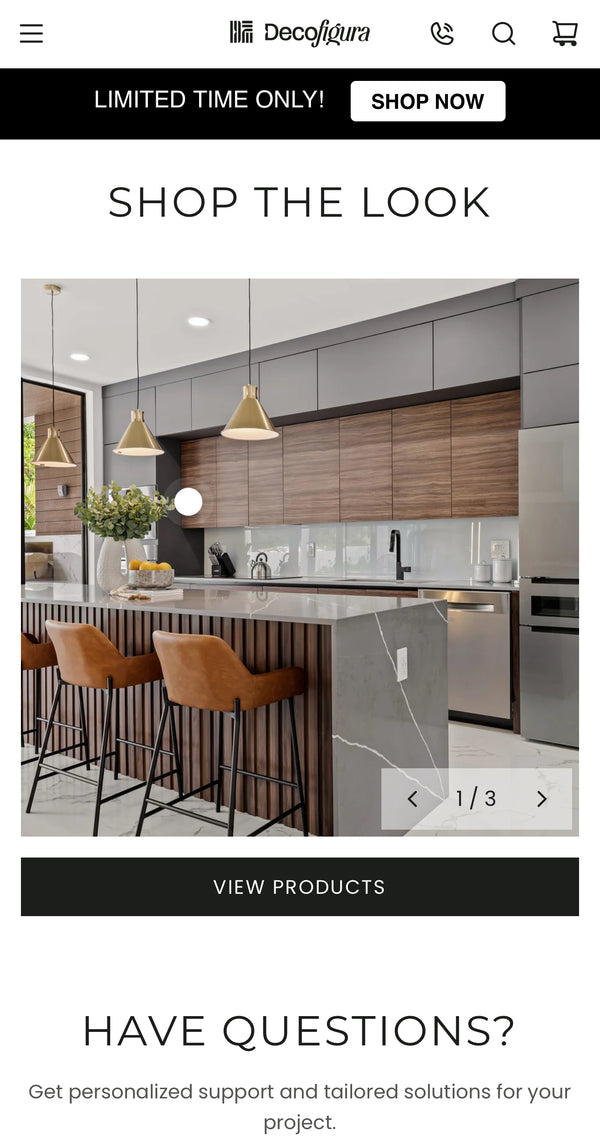 Decofigura USA Trust and conversion Opens the store in a new tab
 -
 Lazo Catalog navigation Opens the store in a new tab
 -
 Excellence Fertility Explain before selling Opens the store in a new tab
 -
 Lummia Product page and email Opens the store in a new tab
 - See
all
Seven years building other people’s stores.
Brands whose projects I have worked on, in agencies and direct. Every logo opens that brand’s store, so you can check who we are talking about. The four with a dot are the ones that also have their project documented here, in the archive.
















Everything that goes in
Seven deliverables. Each line is what it costs to hire on its own today, at market rate — not a padded number to make the discount look bigger.
- A kick-off week on business and brand Product, price, margin, audience and the visual direction of your brand. The week almost nobody does before building, and the one that stops you rebuilding in week four. €1,600
- A complete Shopify store Homepage, visual language, checkout flow and inside pages built to measure on your brand. Not a theme with your logo on top. €3,900
- Catalog loaded and organised Up to 50 products with variants, collections and copy written to sell. €1,500
- Payments, shipping and tax Configured and tested with real purchases before you open. €900
- Analytics from day one So in three months you know what works instead of guessing at it. €700
- The essential automated emails Welcome, abandoned cart and post-purchase. The three that recover the most money. €1,000
- Recorded training for you Videos of your own store: adding a product, changing the homepage, checking orders. €700
What is not included
An offer that does not say where it ends gets paid for later in arguments. This is everything you will pay for or do yourself, said before you sign.
- The cost of Shopify Between €29 and €79 a month depending on the plan. In your name, not mine.
- The domain Around €12 a year, also in your name.
- Product photography I tell you what you need and in what format, and who to shoot it with if you want.
- Ad spend I do not run campaigns. When the traffic arrives, the store will not be the problem.
- The product Manufacturing, supplier and stock are yours. No product, no store.
What happens, and when
- Kick-off: business, brand and decisions closed in writing.
- Homepage signed off and visual language defined.
- Product page, cart and payment working and tested.
- Inside pages, legal pages and catalog loaded.
- Analytics, setup, test purchases and launch.
- Kick-off and brand
- Home and visuals
- Checkout flow
- Inside pages
- Analytics and launch
If your store is not open and taking payments after five weeks, I keep working for free until it is.
The only reason a launch slips is material of yours going missing — product, photos, copy, or a decision nobody made. As long as that arrives on time, the date is on me.
What everyone asks before starting
There are three separate line items and it helps not to mix them. The work, which here is a fixed €3,400 for the five weeks. Shopify, between €29 and €79 a month depending on the plan you need. And the domain, around €12 a year. The last two are in your name and you pay them directly: I am not a middleman you depend on.
The average I see is six months, and almost never for technical reasons: the time goes on comparing platforms, second-guessing prices, and leaving payments and shipping until the end. Building the store is a matter of weeks. Here it is five, and the first one does not touch the store: it goes on business and brand, which is exactly what stops you rebuilding everything halfway through.
I work with Shopify, and the reason is boring: for a store that is starting out, maintenance and security stop being your problem, payments work on day one, and the cost is predictable. If your case calls for something else — an unusual catalog, an integration Shopify does not do — I will tell you on the first call instead of selling you what I happen to know.
Yes, or at least the supplier agreed and the cost price known. You can build a store without physical stock, but not without knowing what you sell and for how much: that is the first thing decided in week 1, and I cannot decide it for you.
That is the point. You get videos recorded on your own store — not on a demo one — for the day-to-day jobs: adding a product, changing the homepage, checking orders. If something breaks I am still here, but you will not depend on me to change a photo.
It can happen, and I would rather say it before taking your money: a store does not bring visitors just by existing. Opening is the beginning, not the end. What you are buying here is that when traffic arrives — from ads, from Google, from your Instagram — the store is not the reason people do not buy. Bringing that traffic is a different job and it is not mine.
The date moves, and that is the only thing that moves it. I give you the list of what I need and when, from the first day of the kick-off. As long as that arrives on time, the five weeks are on me.
Nothing, for a few months. You need your own data before optimising: doing it without data is guessing with your money. Once you have steady sales, that is when Engine 10K comes in.
2 launches a month. That’s it.
This is not marketing scarcity: a launch takes five weeks of my calendar and I do the work myself. If this month is full I will tell you, and you start the next one.
- how the store is built underneath Custom theme, Liquid and integrations
- the free guide, no form 50 pages of decisions, to start preparing them
- stores you can visit All open and running
- the store redesign If what you have is a store that already sells badly
- the rest of the plans The next step, once there are sales