Your whole store rebuilt in 45 days — without closing for a single day or losing one position on Google.
Almost no store has a traffic problem. It has a store that got built in pieces: a theme, then an agency on top, then six apps, then a patch from two years ago. That does not show up in the design. It shows up in the only place that hurts: how many of the people who walk in end up buying.
What a store redesign built to sell actually is
A store redesign means rebuilding the design and the code of an ecommerce site that already sells, while keeping the URLs, the catalog and the rankings it already had. It is not switching themes or repainting the homepage: it is deciding, with data, which pages stay, which get rebuilt, and in what order the change goes live so no traffic is lost along the way.
A redesign is not paid for by what it costs. It is paid for by what is already leaking out every month. Using the numbers of an example store doing around €8,000 a month:
| Today's store | Rebuilt store | |
|---|---|---|
| Monthly visits | 15,000 | 15,000 |
| Conversion rate | 1.1% | 1.6% |
| Average order value | €48 | €54 |
| Revenue | €7,920 | €12,960 |
Not one extra visit. Not one extra euro on ads. These are example numbers, not a promise: they are here to show you where the lever is. Half a point of conversion and six euros of average order value is store work, and store work is exactly what gets rebuilt here.
- Your store already sells, but it got built in pieces and it shows
- You changed themes or agencies and ended up with a Frankenstein
- The brand grew and the store stayed in its three-years-ago version
- You send people your store link with an explanation attached
- You want to run it yourself afterwards, without depending on anyone
- You have not made your first sale yet — that is a launch, not a redesign
- You want the same site in different colours
- You want the cheapest quote around: there are €300 themes for that
- You expect a new design to fix a product nobody wants
- You cannot spare two hours a week to make decisions
Rebuild without breaking
Half the redesigns I see throw away the one thing that was already working: the URLs Google knew, and the few paths people actually bought through. That is why the order is this one and not another.
-
What stays
Before anything gets drawn: which pages bring the visits, which ones convert, where people drop off, and which apps you are paying for and not using. Whatever already works gets protected in writing. Everything else is on the table.
-
The four screens
Home, category, product page and cart. Four screens decide almost everything that happens in a store. They get designed mobile-first, because that is where most people come in, and they get approved before a single line of code is written.
-
The build
A custom theme on Shopify, light, with no stack of apps for things that code solves. Speed and accessibility are not an end-of-project review: it is built that way from the first commit.
-
Going live, without going dark
Redirects one by one, real purchases with real money, and launch outside your peak hours. Your store does not close for a minute, and whatever you had ranked stays where it was.
Three ways to fix a store that has gone stale
All three are legitimate decisions. What changes is when you pay again.
| New theme | Patch it with apps | Full redesign | |
|---|---|---|---|
| Upfront cost | Low | Low, spread out | High and fixed |
| Cost over 12 months | Falls short again | Climbs with every app | Paid once |
| Speed | Whatever the theme brings | Worse with every app | Measured before and after |
| Rankings | At risk if URLs change | Untouched | Protected with redirects |
| Who decides what stays | Nobody | You, on the fly | Decided with data in week 1 |
| When you touch it again | In 12–18 months | Every month | When the business changes |
Stores that look like this today.
Nine stores in production. Hover over any of them to travel the whole page, or click through and walk in: they are all open and you can buy from them right now.
-
 Bell's Cookies A simpler path to checkout Opens the store in a new tab
 -
 Baobab Catalog and brand Opens the store in a new tab
 -
 American Eagle Campaign-ready storefront Opens the store in a new tab
 -
 Tigogreen Product page Opens the store in a new tab
 -
 Paranice Find it, then buy it Opens the store in a new tab
 -
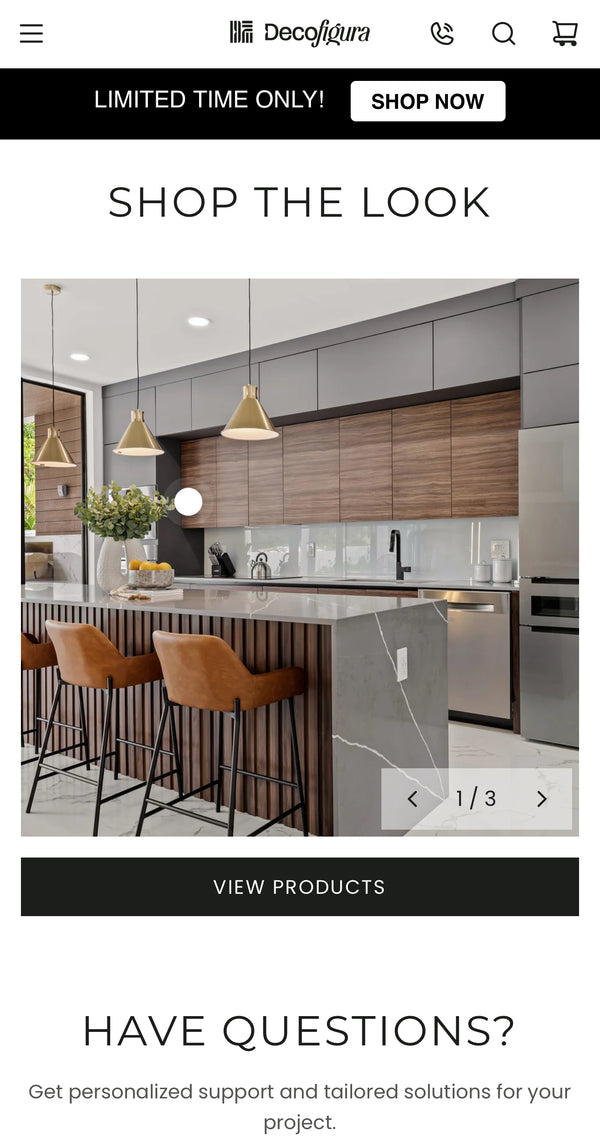 Decofigura USA Trust and conversion Opens the store in a new tab
 -
 Lazo Catalog navigation Opens the store in a new tab
 -
 Excellence Fertility Explain before selling Opens the store in a new tab
 -
 Lummia Product page and email Opens the store in a new tab
 - See
all
Brands whose projects I have worked on.
In agencies and direct, over seven years. Every logo opens that brand’s store, so you can check who we are talking about. The four with a dot are the ones that also have their project documented here, in the archive.
















Everything that goes in
Eleven deliverables. Each line is what it costs to hire on its own today, at market rate — not a padded number to make the discount look bigger.
- A diagnosis of what already works Which pages bring visits and sales today, so they do not get thrown out along the way. It is the part almost nobody does before redesigning. €1,200
- Custom design for the four screens Home, category, product and cart on your brand, designed mobile-first. Not a theme with your logo dropped on top. €3,900
- A Shopify theme built to measure Your own code, with no purchased theme underneath and no apps for what code solves. €4,800
- Catalog and content migration Products, variants, collections, photos and copy, reviewed one by one instead of dumped in bulk. €1,400
- A 301 redirect plan URL by URL, written down and checked. It is exactly what separates a redesign from losing the traffic you already had. €900
- Speed and Core Web Vitals Measured before and after with the same tool on the same weekday, not by eye. €1,200
- Accessibility and the mobile experience Contrast, tap targets and keyboard navigation. It helps the people who need it and, on the way, everyone else. €800
- Analytics and events reinstalled So next month you can actually compare, instead of feeling like it went better. €700
- Real purchases before launch Complete checkouts with real money, on mobile and desktop, with every payment method you have switched on. €900
- Recorded training on your own store Videos of your store, not a demo one: changing the homepage, adding a product, editing a collection. €700
- 30 days of adjustments after launch The things that only show up once real people come in. That month is on me. €1,400
What happens, and when
- Diagnosis closed: what stays, what gets rebuilt, what goes.
- Home and category designed, mobile first.
- Product page and cart designed. Design signed off before any code.
- Custom theme built on the approved screens.
- Catalog migrated, speed measured, analytics reinstalled.
- Redirects, real test purchases and launch.
- A month of adjustments on real traffic, at no extra cost.
If your new store is not live after 45 days, I keep working without invoicing you another euro until it is.
And there is a second one, earlier: the design is signed off in week 3, with everything drawn and not a line of code written. If you are not convinced by what you see at that point, we stop there and I refund what you have paid. The only thing that can move the date is material of yours going missing — photos, copy, access. As long as that arrives on time, the date is on me.
What people ask me
Not if the change ships with a redirect plan. Every old URL points to its new equivalent, the structure is kept unless there is a reason to change it, and we compare Search Console before and after. What sinks a redesign is never the design: it is going live without that plan.
No. Everything is built in a separate environment and goes live outside your peak hours, usually overnight. Your current store keeps selling until the minute before the switch.
I work with Shopify. If you are coming from WooCommerce, PrestaShop or similar, the migration is part of the project, but we talk about it first: some catalogs migrate in a day and others are a project of their own.
The ones that earn their place, yes. Most stores pay for five or six apps a month for things the theme can do. I tell you which ones can go and how much you stop paying every month — in a lot of cases that alone covers part of the redesign.
Copy for the key pages, yes. Product photography I do not shoot: I tell you exactly what you need and in what format, and I can point you to someone if you want.
A theme is a good starting point for someone who already knows what to do with it. What you are buying here is that decision: what stays, what goes and in what order it ships. The design is the consequence, not the product.
You get 30 days of adjustments included. After that, if you want to keep pushing conversion on a store that is now healthy, that is a different engagement. But not before: optimising a broken store means paying twice.
2 redesigns a month. That’s it.
This is not marketing scarcity: a redesign takes six weeks of my calendar and I do the work myself. If the month is full I will tell you, and you start the next one.
- how I build the custom theme The technical side, in detail
- conversion work on Shopify What comes after the redesign
- an audit of your ecommerce If you are not sure the store is the problem
- stores in production All open — you can go and buy something
- building an online store from scratch If you have no store to rebuild yet