Your store open, taking payments and ready to sell in 5 weeks.
Building a store is not the hard part. The order is: most people spend six months stuck on decisions that take a week.
Why six months turn into five weeks
What separates a store that opens from one that does not is the order the decisions get made in. This is what has to close, and by when:
| Today | Target | |
|---|---|---|
| Brand and business decisions | Left for last | Week 1 |
| Homepage and visual language | Inherited from a theme | Week 2 |
| Checkout flow, tested | Tested on launch day | Week 3 |
| Analytics installed | Months later, if ever | Week 5 |
| Store online | 6 months on average | Day 35 |
It is not that we work faster. It is that we never open two fronts at once. Each week ships one piece, and the next one does not start until that piece is signed off.
- You have a product, or a supplier lined up, and you want to sell online
- You would rather open properly than open fast and rebuild in six months
- You want to run the store yourself afterwards
- You know what you are selling, even if you have no idea how to build it
- You have not decided what you are going to sell
- You want the cheapest store possible: there are €50 themes for that
- You expect sales to arrive just because the store exists
- You cannot spare a few hours for the business decisions
Five weeks, five deliveries
One delivery a week, signed off before the next one starts. The first week deliberately does not touch the store: it is the one that stops you rebuilding it in week four.
-
Kick-off: business and brand
What you sell, to whom, at what price and at what margin. And how your brand looks and talks: references, tone, colour and type. Nothing gets drawn until this is closed, because building the store first is decorating a decision you have not made yet.
-
Homepage and visual language
The home and the system that governs everything else: grid, type, colour, buttons, product cards. Once the homepage is signed off, the rest of the store knows what it should look like and stops being argued page by page.
-
The path to checkout
Product page, cart and payment. This is the road the money travels, so it gets built before any other page and tested with real purchases, not screenshots.
-
The inside pages
Collections, search, about, shipping, returns, contact and legal. The pages that answer the doubts that stop a purchase, and the ones the law requires before you can take money.
-
Analytics, setup and launch
Analytics and events from day one, payments, shipping and tax configured and tested, automated emails, recorded training, and launch. You go live measuring, not guessing.
Stores that are open today.
None of them is a portfolio mock-up. Hover over any of them to see the whole page, or walk in and buy something: they are all in production right now.
-
 Bell's Cookies A simpler path to checkout Opens the store in a new tab
 -
 Baobab Catalog and brand Opens the store in a new tab
 -
 American Eagle Campaign-ready storefront Opens the store in a new tab
 -
 Tigogreen Product page Opens the store in a new tab
 -
 Paranice Find it, then buy it Opens the store in a new tab
 -
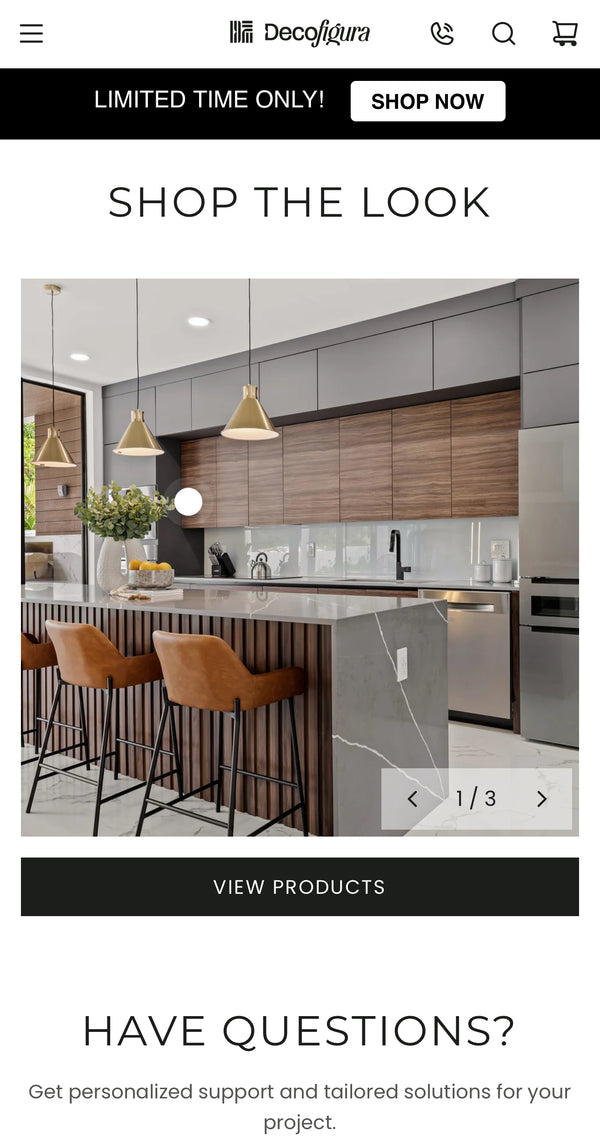 Decofigura USA Trust and conversion Opens the store in a new tab
 -
 Lazo Catalog navigation Opens the store in a new tab
 -
 Excellence Fertility Explain before selling Opens the store in a new tab
 -
 Lummia Product page and email Opens the store in a new tab
 - See
all
Everything that goes in
- A kick-off week on business and brand Product, price, margin, audience and the visual direction of your brand. The week almost nobody does before building, and the one that stops you rebuilding in week four. €1,600
- A complete Shopify store Homepage, visual language, checkout flow and inside pages built to measure on your brand. Not a theme with your logo on top. €3,900
- Catalog loaded and organised Up to 50 products with variants, collections and copy written to sell. €1,500
- Payments, shipping and tax Configured and tested with real purchases before you open. €900
- Analytics from day one So in three months you know what works instead of guessing at it. €700
- The essential automated emails Welcome, abandoned cart and post-purchase. The three that recover the most money. €1,000
- Recorded training for you Videos of your own store: adding a product, changing the homepage, checking orders. €700
What happens, and when
- Kick-off: business, brand and decisions closed in writing.
- Homepage signed off and visual language defined.
- Product page, cart and payment working and tested.
- Inside pages, legal pages and catalog loaded.
- Analytics, setup, test purchases and launch.
If your store is not open and taking payments after five weeks, I keep working for free until it is.
The only reason a launch slips is material of yours going missing — product, photos, copy, or a decision nobody made. As long as that arrives on time, the date is on me.
What people ask me
No. Shopify is billed separately and stays in your name, same as the domain: the store is yours from day one and I am not a middleman you depend on.
I do not shoot it. I tell you exactly what you need and in what format, and I can point you to someone if you want.
That is the point. You get videos recorded on your own store for the day-to-day jobs. If something breaks I am still here, but you will not depend on me to change a photo.
That is Engine 10K. But not before you have steady sales: optimising a store with no data is guessing with your money.
2 launches a month. That's it.
This is not marketing: I do the work on every project myself, so the limit is real. If this month is full I will tell you, and you start the next one.
- building an online store from scratch This same offer, explained in full
- custom Shopify development How I build the store
- stores I have launched All open and running
- the free guide To start preparing the decisions